My Notepad
5 Nov
As I didn’t have much luck with Ubuntu upgrade, this time I install Ubuntu 7.10, fresh. Still, it doesn’t stop the problems that show up on Ubuntu upgrade. Here are some quick fixes for Ubuntu 7.10:
1) Can’t connect / browse the net
This has something to do with bug #81507. Ubuntu 7.10 activates IPv6 by default and in this case, we need to deactivate IPv6.
gksudo gedit /etc/modprobe.d/aliases
Look for a line which contains alias net-pf-10 ipv6. Change it to alias net-pf-10 off.
Save changes. Restart Ubuntu.
2) Can’t update / keep redirected to address 1.0.0.0 instead of archive.ubuntu.com
This is also related with bug #81507. This may not be a good solution, but you can somehow correctly redirected to archive.ubuntu.com by pinging it before you update.
ping archive.ubuntu.com
In my case, the update runs smoothly. Other reports that the update runs slowly.
3) Trouble activating compiz / 3D desktop
To activate compiz, we may or may not need to activate the restricted graphic card drivers. I use ATI Radeon X300 and I’ve managed to activate compiz without using the restricted ATI drivers. Anyway, we need to install compiz.
sudo aptitude install compiz compiz-core compiz-fusion-plugins-extra compiz-fusion-plugins-main compiz-fusion-plugins-unofficial compiz-gnome compiz-plugins compizconfig-settings-manager libcompizconfig-backend-gconf libcompizconfig0 python-compizconfig
Restart X by pressing Ctrl+Alt+Backspace. Try to open System/Preferences/Appearance and choose Visual Effects tab. If succeeded you should see four (not just three) different desktop environments.

If not, then you need to install the restricted drivers. Open System/Administration/Restricted Drivers Manager. Check to enable the accelerated graphics driver. Restart X.

Open the Visual Effects menu again. If you’ve got “The composite extension is not available” message, open X configuration file.
gksudo gedit /etc/X11/xorg.conf
Look for a line which contains Option “Composite” “0″. Change it to Option “Composite” “1″. Save changes. Restart X.
Open the Visual Effects menu again. This time if you’ve got “Desktop effects could not be enabled” message, then you need to install xserver-xgl.
sudo apt-get install xserver-xgl
Restart X.
Phew. Now you should be able to see the four choices on the Visual Effects menu. Choose Custom. Click on Preferences. You can play around now with the available options. If you want to the enable the 3D desktop cube, check for Rotate Cube. And don’t forget to set your workspaces to 4 columns and 1 row.
For 3D desktop cube — hold Ctrl+Alt, left click and drag.

To switch between tasks, the 3D style — hold the Windows key and press Tab repeatedly.

4 Nov
So, it’s been a week since I upgraded my Ubuntu 7.04 to Ubuntu 7.10. The upgrade process was pretty easy. I saw one flashing button on the Update Manager window, telling me to upgrade to Ubuntu 7.10. So I clicked the button and upgrade I did. Some 1.4 GB of download later I restarted the PC and Ubuntu 7.10 was ready to run.
Yippee!
Not quite. The first thing that instantly bothered me was that I could no longer browse the Internet! What the hell!? I mean, there always be a bug or two… hundreds. But being unable to connect to the net is just too much for a bug. I played for a while with my network setting before I decided to go to Google for some helps. But of course, the internet connection was no longer there, so I was forced to switch to Windows XP to do just that. Talk about irony
And just as I expected, there was already some posts on this particular problem. To sum it up, the solution is here. Something to do with IPv6. So I went back to Ubuntu 7.10, apply the solutions, and they worked! The internet connection is back.
I was about to forget this small issue when I stumbled upon other problems while trying to perform some basic Ubuntu operations:
These glitches makes the new Ubuntu 7.10 no longer deemed as “Linux that just works“. Instead it’s now a “Linux that just works — provided you know how to patch the holes“. It’s a shame, really.
Ubuntu 7.04 managed to be a “Linux for human beings” and wins a lot of converts from Windows, including me. After all, the intended users of Ubuntu are the ones that simply want to set up Ubuntu once and proceed with their daily activities, without tinkering deeply into configuration files. Upgrading Ubuntu should not be a ticket to n00b hell.
Next step: I’m going to try a clean installation. If the same problems remain, I have no choice but to deal with the fixes. On the positive side, my current Ubuntu is quite messy anyway, so this clean installation is a necessity.
Update, November 5th 2007: Done with a clean installation. The first bug remains the same: can’t connect to the internet. Hmm… should I switch back to Ubuntu 7.04?
3 Oct
It’s been awhile since I read Handbook for Bloggers and Cyber-Dissidents, an online book about how to stay anonymous on the net. On countries with dismal human right records, anonymous browsing is as vital as breathing. That, or perhaps you just want to lurk around below radar.
The book teaches several methods to keep a person anonymous on the net. The simplest one of them is to use TOR or The Onion Router. So, what is TOR and how to use it?
Quoted from TOR’s wiki:
What is TOR?
Tor is an anonymity network. It protects your privacy on the internet. Tor uses a series of three proxies - computers (or nodes) which communicate on your behalf using their own identifying information - in such a way that none of them know both your identifying information and your destination. Tor can also help people get around restrictive firewalls which censor web content.
Installing TOR
Sounds complicated? Yet its installation turns out to be quite simple. Ubuntu users don’t even need to manually download and install from TOR’s website. Simply type this command:
sudo apt-get install tor
Installing Privoxy
So everything’s set and we can start anonymous browsing? Not yet. We still need to install Privoxy, an HTTP proxy. Why bother?
Quoted from TOR’s wiki:
Using privoxy is necessary because browsers leak your DNS requests when they use a SOCKS proxy directly, which is bad for your anonymity. Privoxy also removes certain dangerous headers from your web requests, and blocks obnoxious ad sites like Doubleclick.
Install privoxy by typing:
sudo apt-get install privoxy
Next, we need to open privoxy’s config file:
gksudo gedit /etc/privoxy/config
and insert this line at the beginning of the file:
forward-socks4a / 127.0.0.1:9050 .
(don’t forget to include the dot at the end of line)
Save the modification and restart privoxy:
sudo /etc/init.d/privoxy restart
Using TOR with FireFox
To use TOR inside FireFox we need to change the browser’s proxy server configuration. Fortunately, there is Torbutton plugin that simplifies the task. Install the plugin, restart FireFox and check the bottom right of the browser window:

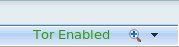
Click once on the “Tor Disabled” label to activate TOR inside FireFox:

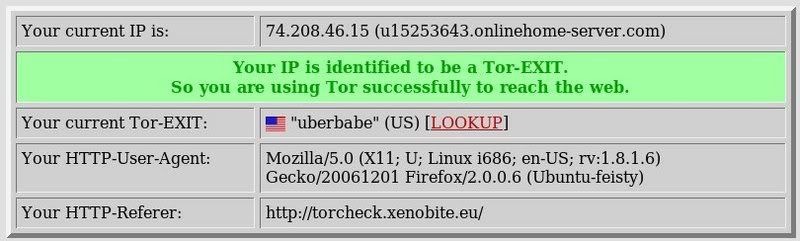
That’s it. Now we need to test whether we’re already anonymous on the net. Open this address:
And if you can see a message like the one below:
then congratulation! You’re anonymous now (well, it has flaws, but at least you’re better off). Click once on “Tor Enabled” label to deactivate TOR inside FireFox.